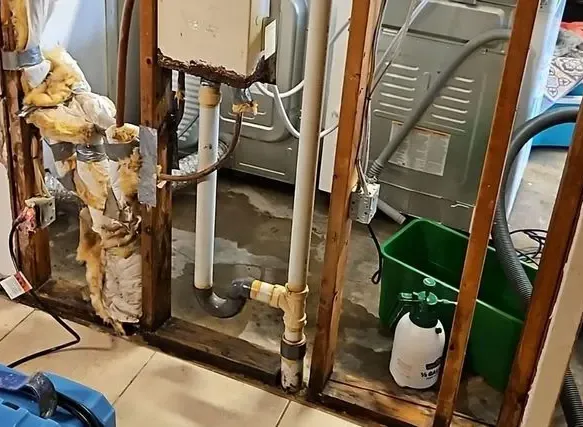
A wet floor and a wet street can look like one problem, but they are two. The water utility owns the main, and the household owns what happens inside the walls.
Key takeaways
- San Gabriel Valley Water Company is the water service provider here, and the city tells residents to report a water break to it.
- The company keeps one contact for 8 am to 5 pm and a separate after hours contact.
- Damage inside a home is a separate job from a break on the utility main.
- An estimate from 2017 shows 71.4 percent of the housing stock was built before 1970, so older pipes and fittings are part of the picture.
- At the house, shut off the water first, then extract and dry without waiting for a diagnosis.
Two different problems with the same wet floor
When water shows up in the street, at the curb or around the meter box, the problem usually sits on the utility side. When it shows up under a sink, on a ceiling or inside a wall, it usually sits inside the house.
The two can overlap, so the first step is working out which side of the meter the water is on.
A simple test helps. If water at the street keeps flowing after the valve at the house is closed, the source is not inside the home.
Because the city sends residents to the utility for a main break, the household's job is to tell the utility and then protect the house.
Who to call about the water main
San Gabriel Valley Water Company is the water service provider in South El Monte. The city tells residents to report a water break to the company, which keeps one contact for 8 am to 5 pm and a separate after hours contact.
That report covers the utility side. It does not cover water that has already come into a house, which needs its own response.
A report goes faster when the caller can describe what is happening.
- Where the water is coming from: the street, the curb or the meter box.
- Whether it is still flowing and roughly how much.
- Whether any water has reached a building or a driveway.
- The street and the nearest cross street, so the crew can find it.
Inside the house: shut off, then extract
A broken pipe inside a home keeps running until someone closes a valve, so the shutoff comes before everything else.
If the sound of running water continues after the valve is closed, the valve may not be sealing. That is a reason to check the meter and call a plumber.
- Find the main shutoff valve for the house and close it.
- Open a low faucet to drain what is left in the pipes.
- Turn off the water heater so it does not run on an empty tank.
- Shut off power to wet rooms at the panel if that can be done safely.
- Move belongings to dry areas and photograph the damage before it is disturbed.
Why housing age and household size matter
Local figures help explain why pipe failures are a steady concern.
An older housing stock
An estimate from 2017 shows 71.4 percent of the housing stock was built before 1970 and 28.6 percent after 1970. In 2018, 73.1 percent of housing units were single family detached homes.
Older homes are more likely to have worn fittings, shutoff valves that stick and supply pipes that have been patched over the years.
Busy households
The 2020 Census counted 4,921 households with an average size of 3.96 people. More people mean more fixtures in daily use and more chances for a worn part to let go.
Renters and landlords
In 2020, 53.4 percent of occupied homes were rented. A burst pipe in a rental involves a tenant who sees it first and an owner who arranges the repair.
Extraction and drying
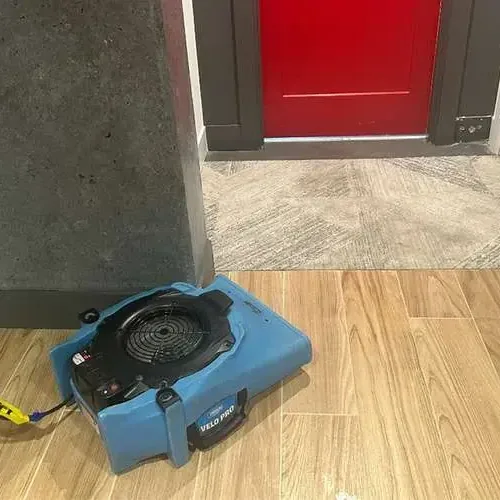
Standing water comes out first. The water extraction service describes pumps and extractors for floors and carpets, and the burst pipe water damage service covers opening walls and ceilings below the break.
Then the drying begins. The structural drying service explains moisture mapping, air movers and dehumidifiers, with readings repeated until framing and subfloor reach a normal level.
Hardwood and laminate floors are checked early, since boards cup quickly once water gets under them.
Moisture readings are taken in the carpet, the baseboards, the lower drywall and the framing, so the drying plan follows the water and does not guess.
- Wet carpet and pad are lifted and usually discarded.
- Drywall that stayed wet is cut back to dry material.
- Cabinets are checked from behind and the toe space is dried.
- Equipment stays in place until the readings match a dry reference.
Apartments, mobile homes and shared walls
In 2018, 8.7 percent of the city's housing units were in buildings of 5 or more units, and mobile homes made up 450 units, or 9.3 percent. The building type changes the drying plan.
In an apartment, water can reach the unit below, and neighbors need to be told. In a mobile home, the floor system and the wall panels need their own readings.
Water that reaches a shared wall can show up as a stain on the neighbor's side first. Telling the neighbor early lets both units be dried before the damage spreads further.
Records, the bill and the next call
Keep the date, the time, photos and the drying readings together. A water bill after a leak may look different from usual, and the provider can explain how it treats an unusual month.
A written list of what was wet, with photos and the dates, makes the conversation with an insurer or a landlord simpler.
Every service is listed on the South El Monte water damage restoration hub.
Questions
Who handles a water main break, the city or the utility?
The city tells residents to report a water break to San Gabriel Valley Water Company, which provides the water service.
Does the utility repair pipes inside a house?
No. The utility handles its own main. Pipes and damage inside the home are the household's matter, handled by a plumber and a restoration crew.
What if water is coming up near the meter box?
Water at the meter box is often a utility side matter, and the provider can say where its responsibility ends. Closing the valve at the house helps rule out a leak inside.
Is an older home more likely to have a burst pipe?
Age raises the odds of worn fittings and valves. An estimate from 2017 puts 71.4 percent of the local housing stock before 1970, so owners often check older shutoffs.
How is a burst pipe in an apartment handled?
The tenant shuts off water if there is a valve, tells the landlord and photographs the damage. The drying crew checks the unit and any walls it shares.
Does insurance cover water from a burst pipe?
Sudden pipe breaks are often covered, but policies differ on the repair of the pipe itself. Reading the policy or asking the insurer gives the answer.