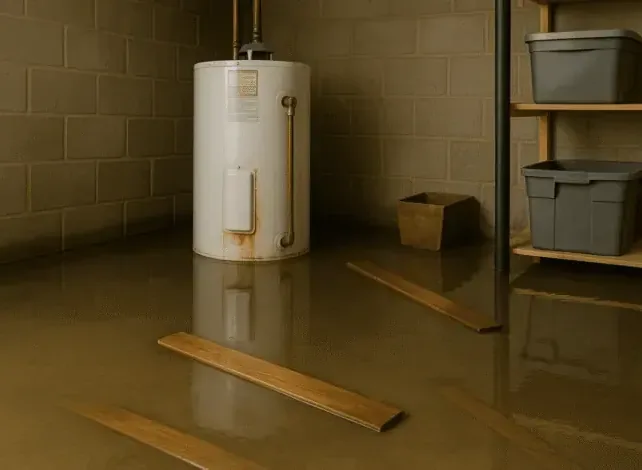
Tank water heaters here usually sit in a garage or a closet. Where the tank sits changes how far a leak spreads and what has to be pulled out afterward.
Key takeaways
- Tank water heaters in this community sit in garages and closets, and the location decides how the water spreads.
- Close the cold water valve above the tank and shut off the power or gas first, then deal with the water on the floor.
- A garage leak spreads across the slab and into stored boxes, while a closet leak climbs drywall and soaks cabinets.
- Earthquake shaking is a known cause of broken supply pipes and water heater failures in the area, so a check after a shake is worthwhile.
- A leaking tank is replaced and not patched, and the cleanup and replacement work best when planned together.
Why the tank location matters
The same failure looks different depending on where the tank stands.
Either way, the first hours count, because wet drywall and cardboard keep drawing water upward.
Garage tanks
A garage tank leaks onto a concrete slab. Water spreads out thin and wide and reaches the walls, stored boxes, tools and anything else on the floor.
The slab itself usually dries well once the standing water is pulled out. The shared wall with the house is what needs careful readings.
Closet tanks
A closet tank sits against interior walls and often beside living space. Water climbs into the bottom of the drywall, runs under flooring and reaches cabinets or the hallway outside the door.
These leaks are more likely to need wall and flooring work, since the water has no open floor to spread across.
Laundry corners and utility sinks
Many garage tanks share the space with a washer, a utility sink or storage shelves. A leak there can follow a drain, or a washer hose can fail at the same time, so the crew checks every source in the room.
First steps when a tank is leaking
Stopping the water comes before the cleanup.
If a gas unit leaks and there is a smell of gas, everyone leaves the house and the gas utility is called. The water can wait.
- Close the cold water valve on the pipe above the tank.
- Turn a gas unit to off or pilot, or switch off the breaker for an electric unit.
- Stay out of water near electrical devices, and shut off power at the panel if the floor around the tank is flooded and the panel is dry.
- Photograph the tank, its base and the floor before cleanup begins.
- Move boxes, shoes and electronics onto dry shelves.
How a tank fails
A tank can leak at a fitting, at the relief valve or through the tank wall itself. A fitting or a valve can often be repaired, while a tank that leaks through its wall is replaced.
Age matters. A tank that has served for many years is more likely to corrode from the inside, and a slow weep can turn into a full failure without much warning.
- A weeping fitting or relief valve is often the first sign.
- Rust stains around the base point to a leak through the tank wall.
- Water at the base with every fitting dry makes the tank itself the suspect.
- A tank that leans or has shifted may have strained its connections.
Earthquake shaking and water heaters
Earthquakes on nearby faults are a known cause of broken supply pipes and water heater failures in the area.
After a strong shake it is worth checking the tank base, the connections and the nearby walls, even when nothing seems wrong. A slow drip behind a closet wall can run for weeks before a stain shows.
- Look for water pooling at the tank base.
- Check flexible connectors for kinks or strain.
- Turn the shutoff valve fully to confirm it still works.
- Look at nearby walls and flooring for fresh damp spots.
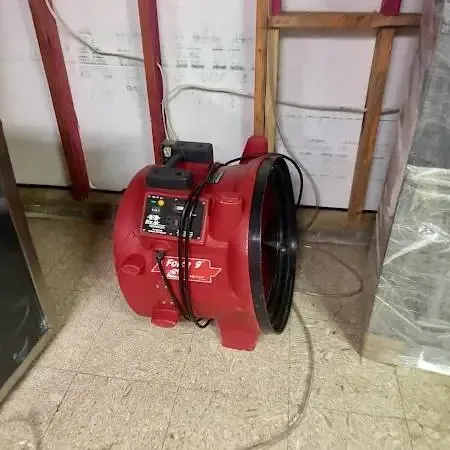
Extraction, removal and drying
The first job is to pull out the standing water. The water extraction service describes pumps and extractors for slab floors and wet flooring.
The water heater leak cleanup service covers the rest: in a garage the crew lifts wet cardboard, checks the bottom of shared walls and dries the slab, and in a closet it lifts wet flooring, cuts the wet bottom of the drywall and dries the stud cavity.
In a closet, shoes, bedding and boxes on the floor soak first. Fabric and cardboard hold water and pass it on to whatever touches them.
- Wet cardboard, fabric and particleboard shelving are usually discarded.
- Baseboards and the bottom of wet drywall are removed so the framing can dry.
- Insulation that soaked up water is pulled and replaced.
- Air movers and dehumidifiers run until readings match a dry reference.
Replacing the tank after the cleanup
A leaking tank is replaced, because patching does not hold. The plumber who sets the new tank can say which permit and inspection apply, and the crew can sequence the drying so a wall is not closed up wet.
If a washer, a utility sink or a softener sits nearby, it is worth checking for a second source. The appliance and supply pipe leak service covers those cases, and the structural drying service explains the final readings.
The scope of work depends on the area, the materials and the drying time, so a written scope after the walkthrough is more useful than a general number.
If the tank has a drain pan, check that its drain is not blocked. A pan only catches small leaks and cannot hold a full tank failure.
Insurance and records
Photos of the tank, the date of the failure and the crew's moisture readings give the insurer a clear picture. Coverage for a tank failure depends on the policy, and some policies treat the water damage and the replacement tank differently.
Keep the label from the old tank and the receipt for the new one, since an insurer may ask for both.
Questions
Should the water heater be turned off if it is leaking?
Yes. Close the cold water valve above the tank and shut off the power or gas, then deal with the standing water.
Is a garage leak less serious than a closet leak?
Not always. A garage slab dries well, but boxes soak and the shared wall with the house can wick water. A closet leak is smaller in area but more likely to enter walls and cabinets.
Can a leaking tank be repaired?
A leaking fitting or valve can often be repaired. A tank that leaks through its wall needs to be replaced.
Why check a water heater after an earthquake?
Shaking is a known cause of broken supply pipes and water heater failures in the area, and a slow leak can hide behind a closet wall.
What gets thrown away after a water heater leak?
Wet cardboard, fabric, particleboard and insulation are usually discarded. Concrete and sealed surfaces are cleaned and dried.
Does homeowners insurance cover a water heater leak?
It depends on the policy. Many policies cover sudden water damage, while the tank itself may be treated differently, so the policy wording has the answer.